Choose a workflow
AddaxAI has two ways of working. Both run the same AI, so the detections and species labels are identical. What differs is what happens next: a folder run hands you the raw results, a project helps you interpret them.
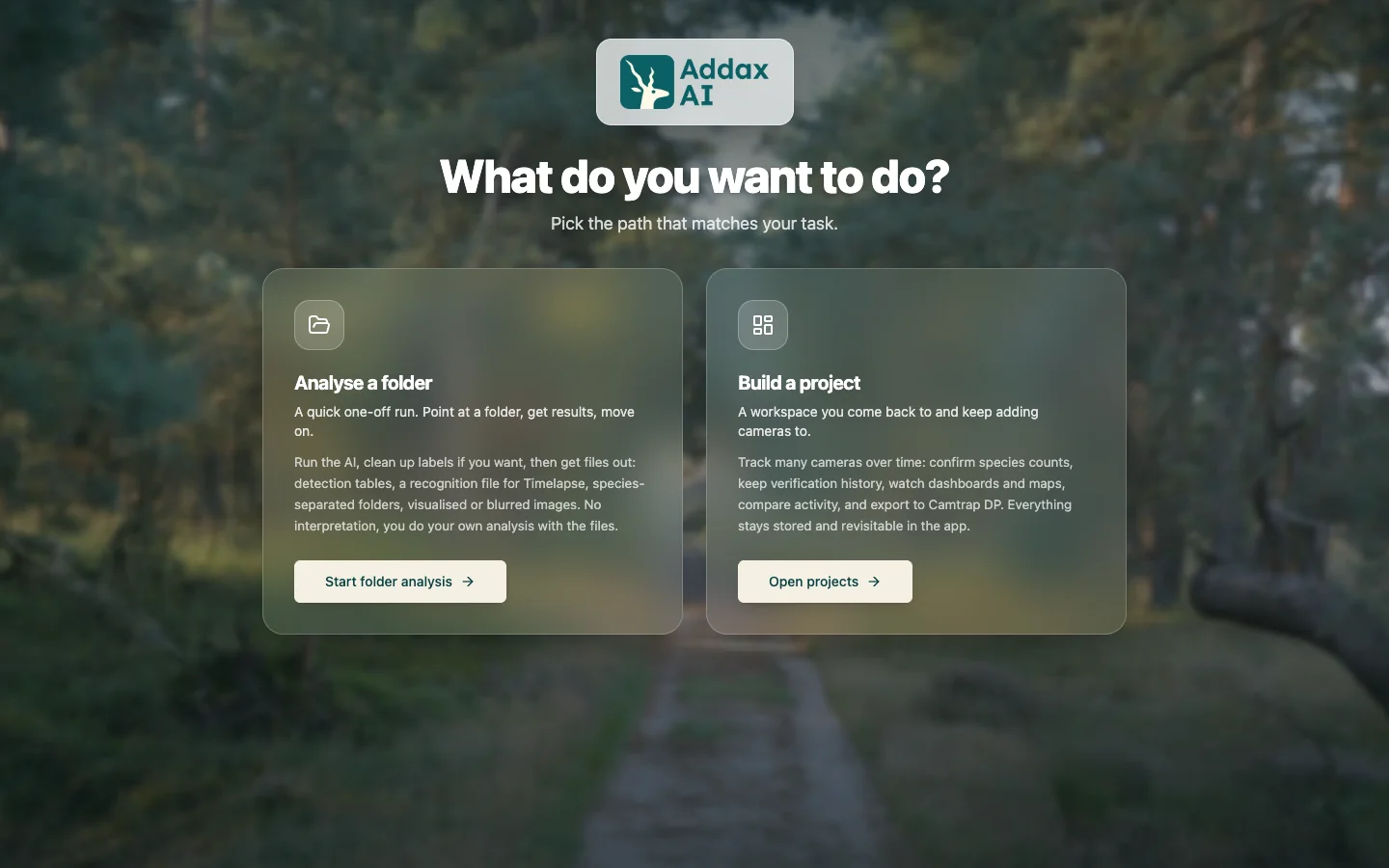
Analyse a folder
A quick, one-off run.
- Best for
- One batch of imagery you will analyse elsewhere.
- You get
- Detection tables, a Timelapse recognition file, species-separated folders, and images with the animals marked.
No map, charts, or history. You take the tables into another tool such as Timelapse, R or Zooniverse.
Build a project
A workspace you keep adding to.
- Best for
- Exploring and interpreting your data inside AddaxAI.
- You get
- Detection tables, a dashboard, a map, activity charts, trap-night rates, a verification history, and Camtrap DP export.
You add where each camera was. That is what powers the map, the rates and the trends. Species folders are a folder run output only.
Nothing is locked in. A folder run can become a project later, keeping every detection and correction, with nothing analysed again.
What differs
The AI output is the same in both. The difference is the layer AddaxAI builds on top.
| Analyse a folder | Build a project | |
|---|---|---|
| Detections and species labels | Same | Same |
| Counts per species | No suggestions | Suggested per event, review on the counts page |
| Trap nights | Not available | Available |
| Rates per 100 trap nights | Not available | Available |
| Maps and graphs | Not available | Available |
| Timelapse export | Available | Not available |
A folder run hands you detections. A project turns them into observations: a species within an event. Ten photos of one deer in two minutes are ten detections, but one observation. See detections, events and observations.
Still not sure
Start with a folder run. It is the quickest way to see what the AI found, and you can promote it to a project whenever you want more, without losing anything or analysing again.
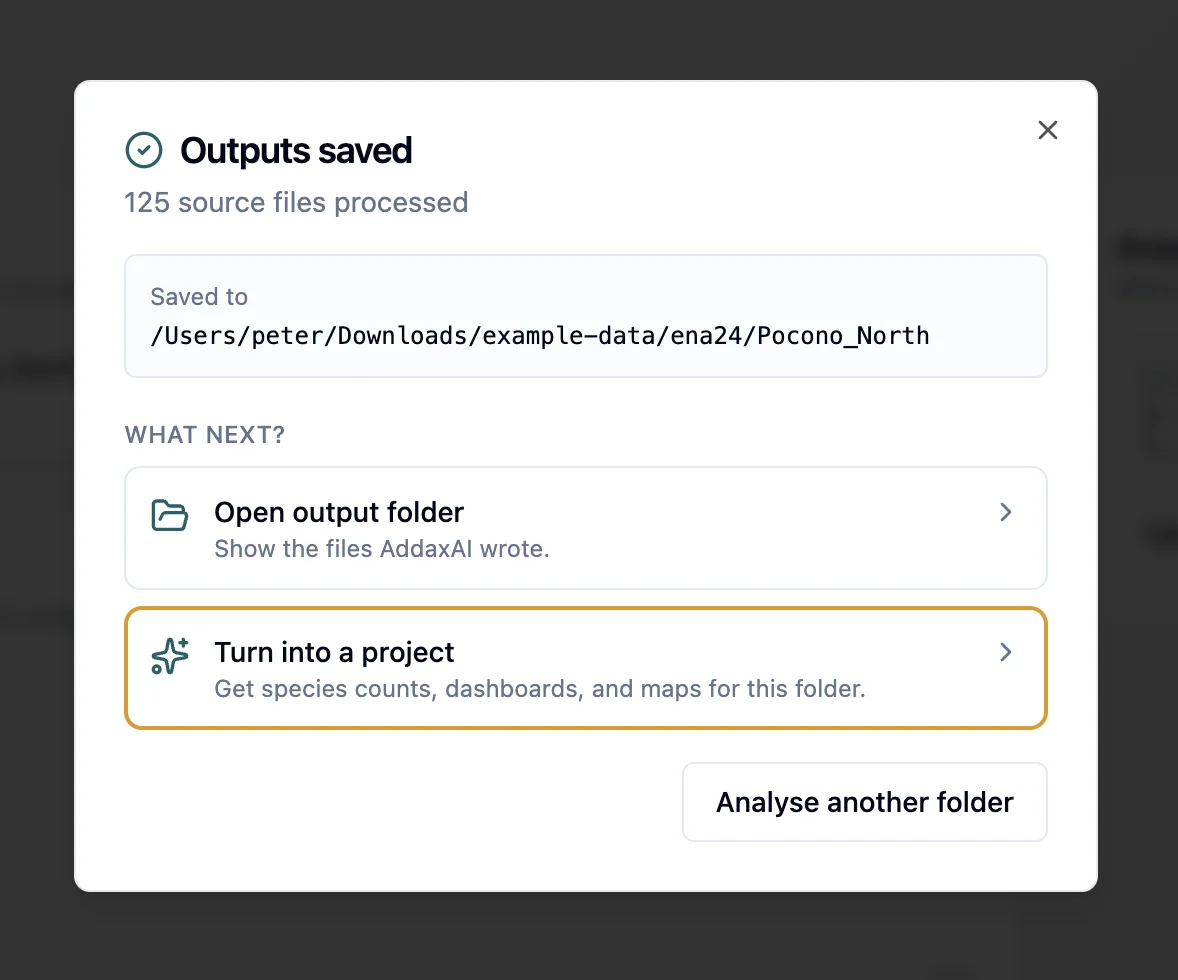
Go straight to a project if you already know you want counts, rates or a map, and you can add where each camera was.
Do you use Timelapse? Run a folder analysis. The recognition file it saves is the one Timelapse reads.